Worcester Art Museum Worcesterãâ Ãâ Ãâ Ãâ Ãâ Ãâ Ãâ Massachusetts Museums for All
 Salisbury Street facade | |
 | |
| Established | 1898 (1898) |
|---|---|
| Location | 55 Salisbury Street Worcester, Massachusetts |
| Coordinates | 42°sixteen′23″N 71°48′07″Due west / 42.273007°N 71.802029°W / 42.273007; -71.802029 |
| Type | Art museum |
| Director | Matthias Waschek[1] |
| Builder | Stephen C. Earle |
| Public transit access | MBTA Framingham/Worcester Line  |
| Website | Worcester Art Museum |
The Worcester Art Museum, also known by its acronym WAM, houses over 38,000 works of art dating from antiquity to the present 24-hour interval and representing cultures from all over the world. WAM opened in 1898 in Worcester, Massachusetts, and ranks among the more than important fine art museums of its kind in the nation. Its holdings include some of the finest Roman mosaics in the U.s.a., outstanding European and American art, and a major collection of Japanese prints. Since acquiring the John Woodman Higgins Armory Collection in 2013, WAM is also abode to the 2d largest drove of artillery and armor in the Americas.[2] In many areas, it was at the forefront in the United states of america, notably as information technology nerveless compages (the Chapter House, 1932),[3] acquired paintings by Monet (1910) and Gauguin (1921),[iv] presented photography as an art form (1904).[5] The Worcester Art Museum also has a conservation lab[6] and twelvemonth-round studio art program for adults and youth.[7]
History [edit]
In September 1896, Stephen Salisbury III and a group of his friends founded the Art Museum Corporation to build an art institution "for the do good of all." Salisbury then gave a tract of land, on what was once the Salisbury farm (now fronting Salisbury Street in Worcester, Massachusetts), equally well as $100,000 USD to construct a building designed by Worcester architect Stephen C. Earle. The museum formally opened in 1898 with the Rev. Daniel Merriman as its first president.[8] [9] The museum's collection then consisted largely of plaster casts of "antiquarian and Renaissance" sculptures, as well as a selection of 5,000 Japanese prints, drawings, and books, willed to the museum from John Chandler Bancroft, son of John Bancroft.[viii]
In 1905, Stephen Salisbury died and left the bulk of his five meg-dollar estate to the museum.[10] The Worcester Art Museum continued to grow and slowly clustered one of the important art collections in the country, with some of the meaning early on works donated or loaned by the artist and collector Helen Bigelow Merriman.[9]
Between 1932 and 1939, the Worcester Art Museum joined a consortium of museums and institutions to sponsor expeditions to the archaeological sites where the city of Antioch once stood. This grouping of museums, including Princeton University, the Musée du Louvre, the Baltimore Museum of Art, and Harvard University'south chapter, Dumbarton Oaks, discovered hundreds of intricate flooring mosaics. The Antioch mosaics, equally they are now known, were divide up amid the institutions The WAM received many mosaics including the Worcester Hunt, which is now installed in the Renaissance Courtroom's flooring.[11]
On May 17, 1972, the museum suffered a major theft of artwork. Two men wearing masks entered the museum but earlier closing.[12] [13] The two men stole The Brooding Adult female and Caput of a Woman past Paul Gauguin, Female parent and Child by Pablo Picasso, and St. Bartholomew, so attributed to Rembrandt, a collection of works worth over one million dollars.[xiv] [13] Four individuals were charged with the theft as well as the theft of seven artworks stolen from the Boyden Library at Deerfield Academy.[12]
In 2013, Worcester's Higgins Arsenal Museum closed its doors and its renowned collection of arms and armor was integrated into WAM'due south.[15] [2] A permanent arms and armor gallery volition open no later than 2023; in the meantime, major works from the Higgins collection are on view in galleries throughout the museum, alongside Greek, Roman, Asian, and European works of fine art. The museum is likewise rethinking its institutional narrative, leveraging the quality and depth of the collection to tell a story that is an culling to those told past other museums in the expanse. The guiding principle for this endeavour is WAM's new mission argument (adopted in 2017): The Worcester Art Museum connects people, communities, and cultures through the experience of art.
Compages [edit]

The Worcester Fine art Museum started as a small three-story building, designed by Stephen C. Earle of Earle & Fisher, and constructed by Norcross Brothers in 1897-98.[iv] Very fiddling of the exterior of this original edifice tin be viewed due to the multiple expansions the museum has undertaken. From the get-go this was the expectation, as Stephen Salisbury and his architects planned the original edifice as the southern component of a larger structure, 5 times the size, which would have a cardinal courtyard and forepart onto Salisbury Street.[16] The first expansion was a rear wing in 1920-21, designed by one of the original architects, Clellan Waldo Fisher, in a matching fashion.[17] The most distinctive addition was added in 1931-33 in the form of the large wing facing Salisbury Street. Designed to include the Chapter Business firm and Renaissance Court, this addition was designed by William Truman Aldrich of Boston, an architect known for museums. This was followed in 1939-forty past the addition of a quaternary floor to the original building, designed by Grand. Adolph Johnson of Worcester.[eighteen]
The next addition was not until 1970, thirty years later on, when the Higgins Education Wing, designed by The Architects Collaborative, was added. This edifice added studios, classrooms, exhibition spaces and a new main entrance. The most recent major addition was the Frances L. Hiatt Wing, added in 1983 on the e side of the original edifice. Designed by Irwin A. Regent & Associates of Worcester, information technology is intended for special exhibitions. These later buildings, though they do not friction match the way of the before buildings, are complementary to them in material and color.[19] In November 2015, the museum unveiled a new walkway ramp at the Salisbury Street entrance. Designed past Kulapat Yantrasast of wHY Architects, the bridge-like construction boldly combines contemporary design with the museum'due south 1933 Beaux-Arts exterior while making the celebrated main archway fully accessible.
In 1927, the museum purchased a 12th-century French chapter house that was originally part of the Benedictine Priory of St. John at Bas-Nueil, in the commune of Berrie, Vienne in France. Installed in 1932, and linked to the museum in 1933 via the k Renaissance Courtroom, the chapter house was the first medieval building ever transported from Europe to America.[13] The remaining portion of the priory at Bas-Nueil was designated a monument historique in 1988. Decorating the Renaissance Court floor is unequivocally one of Worcester's greatest aboriginal treasures – a group of Antioch mosaics dating from the offset through the sixth century A.D, which was excavated at Antioch in Syrian arab republic.
Collection [edit]

In addition to the Roman, mosaic-laden, Renaissance courtroom and French chapter business firm, strengths of the permanent drove include collections of European and North American painting, prints, photographs, and drawings; Asian art; Greek and Roman sculpture and mosaics; and Contemporary fine art.
European paintings include some Flemish Renaissance paintings, an El Greco, a Rembrandt, and a room of Impressionist and 20th-century works by Monet, Matisse, Renoir, Gauguin, and Kandinsky. The American painting collection includes works past Thomas Cole, Winslow Homer, John Singer Sargent, William Morris Hunt, Elizabeth Goodridge, among others. In the 20th-century gallery, the Museum displays works by Franz Kline, Jackson Pollock, and Joan Mitchell.

In 1901, John Chandler Bancroft, a wealthy Bostonian, bequeathed more than iii,000 Japanese prints. The Bancroft Collection spans the history of woodcut printmaking in Japan, with particular strength in rare, early on images from the late 17th and 18th centuries. Salisbury's manor donation included many portraits deputed by his family, also as sculpture, furniture, and silver. These works, by artists such equally Gilbert Stuart, Thomas Crawford, and Samuel F.B. Morse and the craftsmen Paul Revere, Edward Winslow, and Nathanial Hurd, constituted the nucleus of the American collections.[20]
American Art [edit]
-

Freake-Gibbs Painter, Elizabeth Clarke Freake (Mrs. John Freake) and Baby Mary, 1671–1674
-

Freake-Gibbs Painter, John Freake, 1671–1674
European Art [edit]

Asian Art [edit]
-

Mughal (Basawan), Birth of Ghazan Khan, from a manuscript of the "Jami'al-Tawarikh" by Rashid al-Din (1247-1318), about 1596
Arms and Armor [edit]
-

Nagasone Tojiro Mitsumasa, Helmet in the course of a Sea Conch Crush, 1618
-
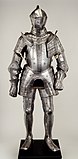
Stefan Rormoser, Armor for Field and Tilt, of Count Franz von Teuffenbach (1516-1578), 1554
-

Workshop of Hans Sumersperger, "Gothic" Hunting Sword, about 1490–1500
Directors [edit]
- Philip T. Gentner 1908–1917
- Raymond Wyer (changed his name in 1923 to Raymond Henniker-Heaton) 1918–1925
- George Westward. Eggers 1926–1930
- Francis Henry Taylor 1931–1939
- Charles H. Sawyer 1940–1947
- Louisa Dresser Campbell (Acting Manager) 1943–1946
- George L. Stout 1947–1955
- Francis Henry Taylor 1955–1957
- Daniel Catton Rich 1958–1970
- Richard Stuart Teitz 1970–1981
- Tom L. Freudenheim 1982–1986
- James A. Welu 1986–2011
- Matthias Waschek 2011 –
Direction [edit]
The Worcester Art Museum operates on a $10M annual upkeep and is governed by an active 25-fellow member Board of Trustees, made up of local, national, and international members with expertise in finance, investment, museum direction, art history, pedagogy, and real manor development. In add-on, WAM has a 200-member Corporation and over 3,000 members and 100 Concern Partners. It employs 65 full-time and 128 part-time personnel (including 56 professional artist faculty) and enlists hundreds of volunteers and docents. In Nov 2017, the Museum was awarded reaccreditation by the American Alliance for Museums.
Prior to becoming Director of WAM in 2011, Matthias Waschek, PhD, served as Executive Manager and Curator of the Pulitzer Arts Foundation (2003–2011) and Caput of Academic Programs at the Louvre Museum in Paris (1992–2003).
Special exhibitions [edit]
April 10, 2021 – January 16, 2022 What the Nazis Stole from Richard Neumann (and the search to get it dorsum) [21]
References [edit]
- ^ "New Director Announced". Worcesterart.org. 2014-02-13. Retrieved 2014-06-25 .
- ^ a b Loos, Ted (19 March 2014). "What Comes Next, After the Troops Are Dismissed" – via NYTimes.com.
- ^ "Worcester Art Museum – Chapter House". www.worcesterart.org.
- ^ "Worcester Art Museum – The Brooding Woman". world wide web.worcesterart.org.
- ^ "Photography at the Worcester Art Museum: Keeping Shadows," by David Acton, copyright 2004 Worcester Art Museum (ISBN 0-936042-10-nine)
- ^ "Worcester Art Museum – Conservation at the Worcester Art Museum". world wide web.worcesterart.org.
- ^ "classes". portal.worcesterart.org.
- ^ a b New Art Museum. New York Times. July half-dozen, 1902. Retrieved Feb 21, 2011
- ^ a b Welu, James. "Helen Bigelow Merriman and the Worcester Art Museum". Holy Cross College website.
- ^ Salisbury'southward Bequests. November 21, 1905. Retrieved February 21, 2011
- ^ Worcester Art Museum Restores Edge Panels to Worcester Hunt, Largest Antioch Floor Mosaic in America. Worcester Art Museum. Retrieved Jan 26, 2011
- ^ a b Suspects in Art Theft Face Court on June one. The Telegraph. May 23, 1972. Retrieved Feb 21, 2011.
- ^ a b Thieves Take Art Works. Victoria Advocate. May 18, 1972. Retrieved February 21, 2011
- ^ Miner, Bradford. "twoscore years since heist at Worcester Fine art Museum". Telegram . Retrieved 25 July 2012.
- ^ Duckett, Richard (eight March 2013). "Higgins Armory Museum to close after 82 years". Worcester Telegram and Gazette. Retrieved 8 March 2013.
- ^ Articles of Incorporation, Past-laws, Subscribers to the Building Fund, and the Annual Reports of the Directors for 1896-1897-1898 (Worcester: Worcester Fine art Museum, 1899)
- ^ Celebrated Building Detail: WOR.375, Massachusetts Cultural Resource Data System.
- ^ "Worcester: Plans & Additions" in Art News 37, no. 32 (May half-dozen, 1939): 18.
- ^ Elliott B. Knowlton, Worcester'southward Best: A Guide to the Urban center'due south Architectural Heritage (Worcester: Worcester Heritage Preservation Society, 1984)
- ^ Judith H. Dobrzynski (March 14, 2012), How an Acquisition Fund Burnishes Reputations New York Times.
- ^ "What the Nazis Stole from Richard Neumann (and the search to get it back) | Worcester Fine art Museum". www.worcesterart.org . Retrieved 2021-04-07 .
This exhibition will present 14 paintings and sculptures from the in one case extensive art collection of Dr. Richard Neumann (1879-1959), recently reunited post-obit his and his family unit's efforts over 75 years to regain possession of them.
{{cite web}}: CS1 maint: url-condition (link)
External links [edit]
 Media related to Worcester Fine art Museum at Wikimedia Commons
- Official website
- WAM library at the Internet Archive
hughesdeforgand99.blogspot.com
Source: https://en.wikipedia.org/wiki/Worcester_Art_Museum

Post a Comment for "Worcester Art Museum Worcesterãâ Ãâ Ãâ Ãâ Ãâ Ãâ Ãâ Massachusetts Museums for All"