Social Perspectives on Art Education in the Us Teaching Visual Culture in a Democracy
16.2 Sociological Perspectives on Pedagogy
Learning Objectives
- List the major functions of education.
- Explain the problems that disharmonize theory sees in instruction.
- Depict how symbolic interactionism understands education.
The major sociological perspectives on instruction fall nicely into the functional, conflict, and symbolic interactionist approaches (Ballantine & Hammack, 2009). Tabular array xvi.i "Theory Snapshot" summarizes what these approaches say.
Table 16.ane Theory Snapshot
| Theoretical perspective | Major assumptions |
|---|---|
| Functionalism | Pedagogy serves several functions for society. These include (a) socialization, (b) social integration, (c) social placement, and (d) social and cultural innovation. Latent functions include child care, the establishment of peer relationships, and lowering unemployment by keeping high school students out of the full-fourth dimension labor force. |
| Conflict theory | Instruction promotes social inequality through the use of tracking and standardized testing and the impact of its "hidden curriculum." Schools differ widely in their funding and learning weather condition, and this type of inequality leads to learning disparities that reinforce social inequality. |
| Symbolic interactionism | This perspective focuses on social interaction in the classroom, on the playground, and in other schoolhouse venues. Specific research finds that social interaction in schools affects the development of gender roles and that teachers' expectations of pupils' intellectual abilities bear on how much pupils learn. |
The Functions of Education
Functional theory stresses the functions that education serves in fulfilling a society'southward diverse needs. Perhaps the most important function of teaching is socialization. If children demand to acquire the norms, values, and skills they need to function in society, then pedagogy is a principal vehicle for such learning. Schools teach the three Rs, equally we all know, but they as well teach many of the society's norms and values. In the United States, these norms and values include respect for say-so, patriotism (call back the Pledge of Allegiance?), punctuality, individualism, and contest. Regarding these last 2 values, American students from an early age compete as individuals over grades and other rewards. The state of affairs is quite the opposite in Nihon, where, as we saw in Chapter 4 "Socialization", children learn the traditional Japanese values of harmony and group belonging from their schooling (Schneider & Silverman, 2010). They learn to value their membership in their homeroom, or kumi, and are evaluated more than on their kumi's performance than on their own individual operation. How well a Japanese child's kumi does is more than important than how well the child does as an private.
A second office of didactics is social integration. For a society to work, functionalists say, people must subscribe to a common set of beliefs and values. As we saw, the evolution of such common views was a goal of the system of costless, compulsory didactics that developed in the 19th century. Thousands of immigrant children in the United States today are learning English language, U.S. history, and other subjects that help prepare them for the workforce and integrate them into American life. Such integration is a major goal of the English language-only movement, whose advocates say that simply English should be used to teach children whose native natural language is Spanish, Vietnamese, or whatever other language their parents speak at dwelling. Critics of this motion say it slows down these children'south pedagogy and weakens their ethnic identity (Schildkraut, 2005).
A third function of pedagogy is social placement. Beginning in form schoolhouse, students are identified past teachers and other school officials either equally brilliant and motivated or every bit less brilliant and even educationally challenged. Depending on how they are identified, children are taught at the level that is thought to adapt them best. In this way they are prepared in the almost appropriate way possible for their later station in life. Whether this process works every bit well every bit information technology should is an important issue, and nosotros explore information technology farther when we hash out schoolhouse tracking before long.
Social and cultural innovation is a fourth office of didactics. Our scientists cannot make of import scientific discoveries and our artists and thinkers cannot come up with neat works of fine art, poetry, and prose unless they have outset been educated in the many subjects they demand to know for their chosen path.
Effigy 16.1 The Functions of Didactics
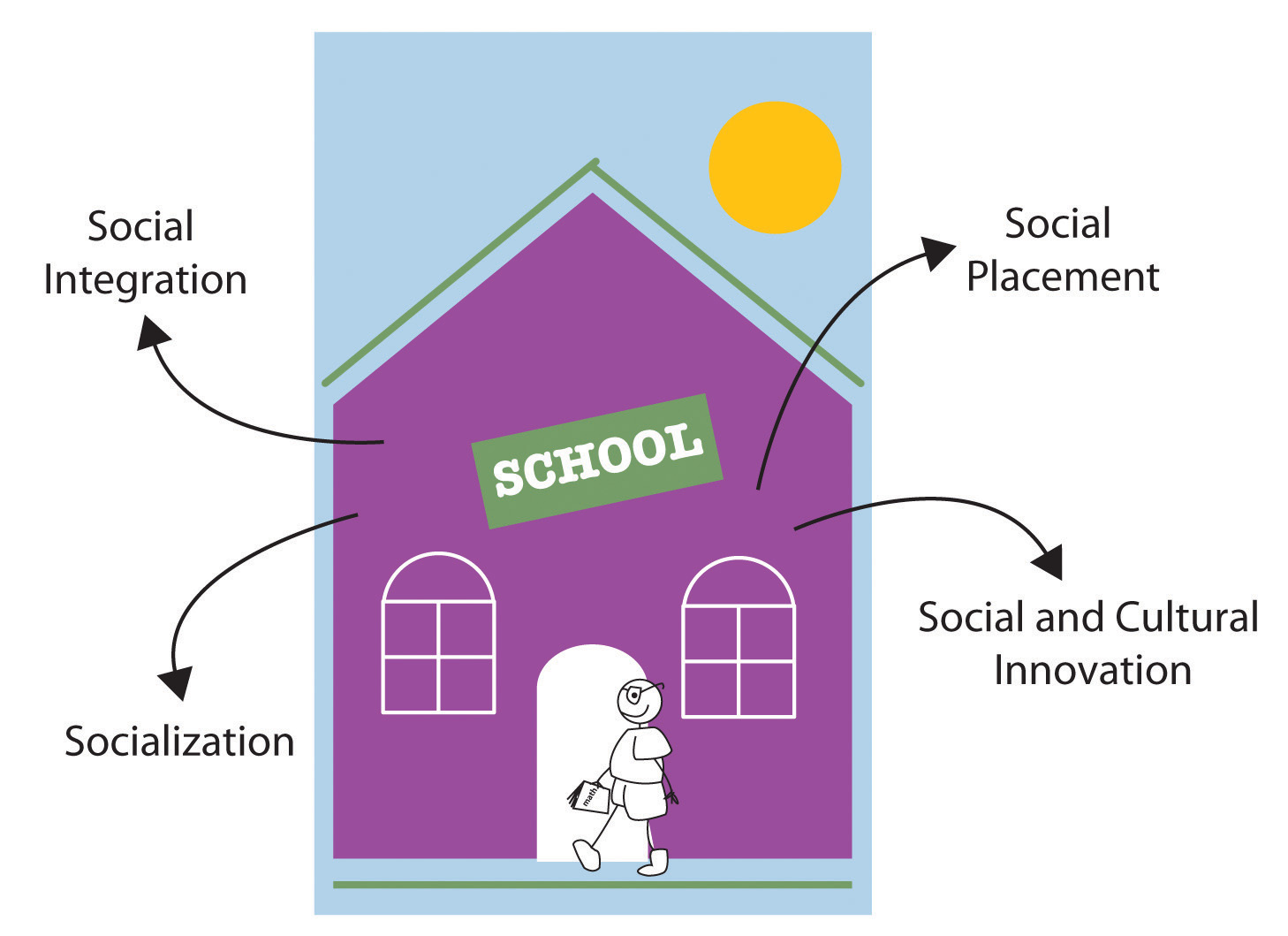
Schools ideally perform many important functions in modern society. These include socialization, social integration, social placement, and social and cultural innovation.
Didactics also involves several latent functions, functions that are by-products of going to school and receiving an education rather than a direct effect of the education itself. I of these is child intendance. In one case a child starts kindergarten and then beginning form, for several hours a day the child is taken care of for free. The establishment of peer relationships is another latent function of schooling. Almost of us met many of our friends while nosotros were in school at whatever grade level, and some of those friendships endure the remainder of our lives. A concluding latent function of pedagogy is that it keeps millions of high school students out of the full-time labor forcefulness. This fact keeps the unemployment rate lower than it would be if they were in the labor forcefulness.
Education and Inequality
Disharmonize theory does not dispute most of the functions just described. Nonetheless, it does give some of them a unlike slant and talks about various ways in which education perpetuates social inequality (Loma, Macrine, & Gabbard, 2010; Liston, 1990). One example involves the function of social placement. As most schools runway their students starting in grade school, the students thought past their teachers to be bright are placed in the faster tracks (especially in reading and arithmetic), while the slower students are placed in the slower tracks; in high school, three common tracks are the college track, vocational track, and general track.
Such tracking does have its advantages; it helps ensure that bright students learn as much every bit their abilities allow them, and it helps ensure that slower students are non taught over their heads. Simply, conflict theorists say, tracking also helps perpetuate social inequality past locking students into faster and lower tracks. Worse yet, several studies show that students' social class and race and ethnicity bear on the rail into which they are placed, even though their intellectual abilities and potential should be the only things that matter: white, middle-form students are more likely to exist tracked "up," while poorer students and students of color are more than probable to be tracked "down." In one case they are tracked, students learn more if they are tracked up and less if they are tracked downwardly. The latter tend to lose cocky-esteem and begin to think they take niggling academic power and thus practice worse in school considering they were tracked down. In this way, tracking is thought to be proficient for those tracked upward and bad for those tracked down. Conflict theorists thus say that tracking perpetuates social inequality based on social class and race and ethnicity (Ansalone, 2006; Oakes, 2005).
Social inequality is likewise perpetuated through the widespread employ of standardized tests. Critics say these tests go along to be culturally biased, as they include questions whose answers are most likely to be known by white, centre-class students, whose backgrounds have afforded them various experiences that assistance them answer the questions. They also say that scores on standardized tests reflect students' socioeconomic status and experiences in addition to their academic abilities. To the extent this critique is true, standardized tests perpetuate social inequality (Grodsky, Warren, & Felts, 2008).
Every bit we will see, schools in the United states of america also differ mightily in their resources, learning conditions, and other aspects, all of which bear upon how much students tin can learn in them. Simply put, schools are unequal, and their very inequality helps perpetuate inequality in the larger order. Children going to the worst schools in urban areas face many more obstacles to their learning than those going to well-funded schools in suburban areas. Their lack of learning helps ensure they remain trapped in poverty and its related problems.
Conflict theorists likewise say that schooling teaches a hidden curriculum, by which they mean a fix of values and beliefs that support the condition quo, including the existing social hierarchy (Booher-Jennings, 2008) (see Affiliate 4 "Socialization"). Although no one plots this behind closed doors, our schoolchildren learn patriotic values and respect for authority from the books they read and from various classroom activities.
Symbolic Interactionism and School Beliefs
Symbolic interactionist studies of education examine social interaction in the classroom, on the playground, and in other school venues. These studies help u.s. understand what happens in the schools themselves, only they besides assist u.s. empathise how what occurs in school is relevant for the larger society. Some studies, for instance, testify how children'southward playground activities reinforce gender-role socialization. Girls tend to play more than cooperative games, while boys play more competitive sports (Thorne, 1993) (encounter Affiliate 11 "Gender and Gender Inequality").
Another torso of research shows that teachers' views about students can bear upon how much the students learn. When teachers think students are smart, they tend to spend more time with them, to phone call on them, and to praise them when they give the right reply. Not surprisingly these students learn more because of their teachers' behavior. Simply when teachers think students are less brilliant, they tend to spend less fourth dimension with them and act in a manner that leads the students to learn less. I of the kickoff studies to discover this case of a cocky-fulfilling prophecy was conducted by Robert Rosenthal and Lenore Jacobson (1968). They tested a group of students at the offset of the school year and told their teachers which students were bright and which were non. They tested the students again at the end of the schoolhouse year; not surprisingly the bright students had learned more during the twelvemonth than the less brilliant ones. Just it turned out that the researchers had randomly decided which students would exist designated bright and less bright. Because the "bright" students learned more during the school yr without actually being brighter at the kickoff, their teachers' beliefs must have been the reason. In fact, their teachers did spend more than time with them and praised them more than often than was true for the "less bright" students. To the extent this type of self-fulfilling prophecy occurs, it helps us understand why tracking is bad for the students tracked down.
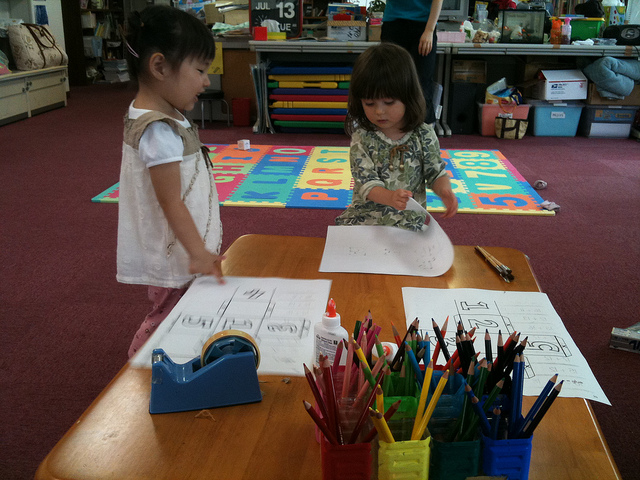
Research guided past the symbolic interactionist perspective suggests that teachers' expectations may influence how much their students learn. When teachers expect fiddling of their students, their students tend to learn less.
Other enquiry focuses on how teachers treat girls and boys. Several studies from the 1970s through the 1990s found that teachers call on boys more than often and praise them more often (American Association of University Women Educational Foundation, 1998; Jones & Dindia, 2004). Teachers did non do this consciously, merely their behavior nonetheless sent an implicit message to girls that math and science are not for girls and that they are not suited to practice well in these subjects. This body of research stimulated efforts to educate teachers about the ways in which they may unwittingly send these messages and almost strategies they could utilise to promote greater involvement and accomplishment by girls in math and science (Battey, Kafai, Nixon, & Kao, 2007).
Primal Takeaways
- According to the functional perspective, education helps socialize children and set them for their eventual archway into the larger society as adults.
- The conflict perspective emphasizes that instruction reinforces inequality in the larger lodge.
- The symbolic interactionist perspective focuses on social interaction in the classroom, on school playgrounds, and at other school-related venues. Social interaction contributes to gender-role socialization, and teachers' expectations may bear upon their students' performance.
For Your Review
- Review how the functionalist, conflict, and symbolic interactionist perspectives understand and explain education. Which of these 3 approaches practise you most prefer? Why?
References
American Association of University Women Educational Foundation. (1998). Gender gaps: Where schools still fail our children. Washington, DC: American Clan of University Women Educational Foundation.
Ansalone, G. (2006). Tracking: A return to Jim Crow. Race, Gender & Grade, 13, 1–2.
Ballantine, J. H., & Hammack, F. 1000. (2009). The sociology of education: A systematic assay (sixth ed.). Upper Saddle River, NJ: Prentice Hall.
Battey, D., Kafai, Y., Nixon, A. Due south., & Kao, Fifty. L. (2007). Professional person development for teachers on gender equity in the sciences: Initiating the conversation. Teachers College Record, 109(i), 221–243.
Booher-Jennings, J. (2008). Learning to characterization: Socialisation, gender, and the hidden curriculum of high-stakes testing. British Journal of Sociology of Pedagogy, 29, 149–160.
Grodsky, East., Warren, J. R., & Felts, Eastward. (2008). Testing and social stratification in American education. Annual Review of Folklore, 34(i), 385–404.
Hill, D., Macrine, S., & Gabbard, D. (Eds.). (2010). Capitalist education: Globalisation and the politics of inequality. New York, NY: Routledge; Liston, D. P. (1990). Capitalist schools: Explanation and ethics in radical studies of schooling. New York, NY: Routledge.
Jones, S. Chiliad., & Dindia, K. (2004). A meta-analystic perspective on sex disinterestedness in the classroom. Review of Educational Research, 74, 443–471.
Oakes, J. (2005). Keeping track: How schools structure inequality (2nd ed.). New Haven, CT: Yale Academy Press.
Rosenthal, R., & Jacobson, Fifty. (1968). Pygmalion in the classroom. New York, NY: Holt.
Schildkraut, D. J. (2005). Press "one" for English: Language policy, public opinion, and American identity. Princeton, NJ: Princeton University Press.
Schneider, L., & Silverman, A. (2010). Global sociology: Introducing five contemporary societies (5th ed.). New York, NY: McGraw-Colina.
Thorne, B. (1993). Gender play: Girls and boys in school. New Brunswick, NJ: Rutgers University Printing.
hughesdeforgand99.blogspot.com
Source: https://open.lib.umn.edu/sociology/chapter/16-2-sociological-perspectives-on-education/

Post a Comment for "Social Perspectives on Art Education in the Us Teaching Visual Culture in a Democracy"