Why Did Some Criticize Fdrs Art Programs While Some Defended Them
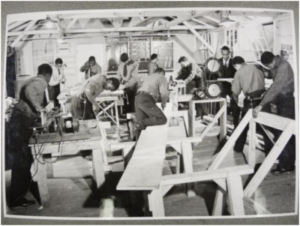
CCC men at woodworking shop in Motel John, Maryland
The CCC offered African American enrollees the opportunity to learn a trade.
Both friends and critics of the New Deal betoken to actions past President Franklin Roosevelt and the exclusion of African Americans from some programs as evidence that the New Deal was racist. But in club to evaluate the New Deal fairly we have to ask what the country was similar at the time.
While the New Deal revolutionized many aspects of social club and government, it was not able to overcome America'southward entrenched racial order. The fact is, the United States had been a white supremacist country from the beginning—rife with genocide and suppression of native people; slavery followed by Jim Crow; and the exploitation and exclusion of Chinese, Mexicans, and Filipinos. That was the earth the New Deal inherited. The Civil Rights Movement would not arrive for another generation.
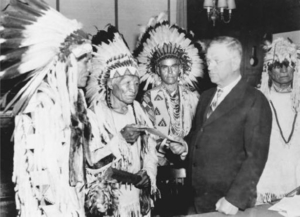
Indian New Bargain
Secretary of the Interior Harold L. Ickes hands the first constitution issued under the Indian Reorganization Act to delegates of the Confederated Tribes of the Flathead Indian Reservation, Montana, 1935.
Photo Credit: Courtesy Library of Congress, Prints and Photographs Segmentation
The New Dealers faced the daunting chore of overcoming long-established patterns of bigotry and social hierarchy. They did not challenge the prevailing racial lodge head-on, simply that's not the aforementioned as saying information technology was racist. The leading New Dealers—Eleanor Roosevelt, Harold Ickes, Frances Perkins, and Harry Hopkins—were outspoken critics of racial bigotry and made a systematic effort to include people of color in New Deal programs. Their overall achievement was impressive, if far from perfect.
Most New Deal programs reached out to include Native Americans, African Americans, Latinos, and Asians to an unprecedented degree. People of colour worked in large numbers in all the large relief programs and there were instruction, recreation, and wellness programs aimed specifically at helping them.
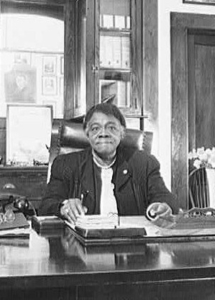
Mary McLeod Bethune, 1943
An educator, author and civil rights advocate, and counselor to FDR and First Lady Eleanor Roosevelt, she headed the Negro Sectionalisation of the National Youth Administration.
Photo Credit: Picyrl
For example, the Indian Reorganization Human activity of 1934, the and then-called "Indian New Deal," was a radical shift in federal policy. It was a genuine attempt to accolade native sovereignty, meliorate reservation lands, promote artisan crafts, and build schools for native children. On the other hand, the Bonneville and Grand Coulee dams congenital on the Columbia River flooded thousands of acres of Native American lands without even providing irrigation water to local reservations.
Other New Deal achievements baked in discriminatory policies. The Social Security and National Labor Relations Acts of 1935 made an exception for agronomical and domestic workers, effectively excluding African Americans and Chicanos as a event of compromises FDR made with Southern Democrats and Western Growers to get these programs through Congress.
Nonetheless, FDR put African Americans into positions of power not seen since Reconstruction. A group of prominent African Americans were popularly known as FDR's Black Cabinet. They included Lawrence Oxley, a high-ranking official in the Department of Labor; Mary McLeod Bethune, the director of the National Youth Administration'south Office of Negro Affairs; and Robert Weaver, who served as an economic advisor to the president. FDR also appointed William Hastie as the first-ever African-American federal judge.
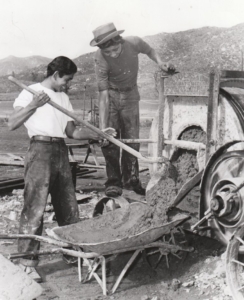
Men at work
The Farm Security Administration established camps for migrant farm workers in California, and the CCC and WPA hired unemployed Mexican Americans on relief jobs.
By Executive Club, discrimination was barred in the relief agencies and workers were paid equal wages regardless of race nearly everywhere. The WPA employed hundreds of thousands of African-American, Asian, Mexican, and Native American citizens. These were non but men doing manual labor. Women of color were hired equally teachers, social workers, librarians, and in other professional and service sectors, often working on integrated teams.
The Noncombatant Conservation Corps (CCC) is frequently cited as a segregated programme, only at the starting time it was integrated. Intense opposition in rural areas of the North and across the South ultimately forced the CCC to segregate its camps.
The New Deal concluded President Hoover's ambitious deportation of Mexicans and invested heavily in Puerto Rico, the Virgin Islands, and Hawai'i. Yet, President Roosevelt made a catastrophically bad determination to issue Executive Order 9066, which imprisoned some 120,000 innocent Japanese Americans as the country went to war at the stop of 1942.
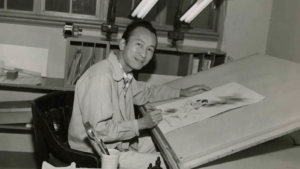
WPA artist Tyrus Wong
Many minority artists were employed or commissioned by New Deal fine art programs.
While the New Deal fell far curt of ending racial discrimination, it set in motion the forces that would challenge Jim Crow in the postwar era. The number of people of color working for the federal government increased dramatically during the New Deal and many were elevated to of import positions in government. Many of the black leaders Roosevelt relied upon would proceed to assistance launch the Ceremonious Rights Movement. Integration of the Armed Forces would begin past the end of World War Two. Supreme Court justices appointed past FDR were crucial to postwar judgments confronting segregated pedagogy, anti-miscegenation laws, and housing discrimination.
The New Bargain marked an important footstep forward in addressing the issues of U.Southward. society. Its outlook, policies, and programs, while far from perfect, contributed to the advancement of millions of citizens of color as part of its massive endeavor to improve the lives of all working people, seniors, children and other ordinary Americans.

FDR'south "Black Chiffonier"
An breezy chiffonier of African Americans served equally public policy advisors to President Franklin D. Roosevelt and First Lady Eleanor Roosevelt,. Forepart row, left to right: Dr. Ambrose Caliver, Dr. Roscoe C. Brown, Dr. Robert C. Weaver, Joseph H. Evans, Dr. Frank Horne, Mary McLeod Bethune, Lt. Lawrence A. Oxley, Dr. William J. Thompkins, Charles Due east. Hall, William I. Houston, Ralph E. Mizelle. Back row, left to right: Dewey R. Jones, Edgar Brown, J. Parker Prescott, Edward H. Lawson, Jr., Arthur Weiseger, Alfred Edgar Smith, Henry A. Hunt, John W. Whitten, Joseph R. Houchins. Source: Scurlock Studio, "President Franklin D. Roosevelt's "Black Cabinet" taken in March 1938″
Photograph Credit: Wikipedia
hughesdeforgand99.blogspot.com
Source: https://livingnewdeal.org/was-the-new-deal-racist-2/

Post a Comment for "Why Did Some Criticize Fdrs Art Programs While Some Defended Them"