N Egyptian Art the Scarab Beetle Is Associated With
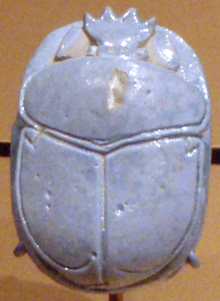
Scarabs were pop amulets and impression seals in aboriginal Egypt. They survive in large numbers and, through their inscriptions and typology, they are an important source of information for archaeologists and historians of the aboriginal world. They too represent a pregnant body of aboriginal art.
For reasons that are non clear (although likely continued to the religious significance of the Egyptian god Khepri), amulets in the form of scarab beetles had become enormously pop in Ancient Egypt by the early Eye Kingdom (approx. 2000 BCE) and remained pop for the rest of the pharaonic period and beyond. During that long catamenia the function of scarabs repeatedly changed. Primarily amulets, they were also inscribed for employ as personal or administrative seals or were incorporated into jewelry. Some scarabs were created for political or diplomatic purposes to commemorate or annunciate royal achievements. By the early New Kingdom, heart scarabs had go role of the battery of amulets protecting mummies.
From the middle Bronze Age, other aboriginal peoples of the Mediterranean and the Middle East imported scarabs from Egypt and likewise produced scarabs in Egyptian or local styles, especially in the Levant.
Scarabs are a common apocryphal product of present day forgers.[1]
Description [edit]

Scarabs are usually identified as the dung protrude Scarabaeus sacer, here rolling a brawl of dung.
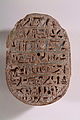
Scarabs were produced in vast numbers for many centuries and many thousands accept survived. They were more often than not intended to be worn or carried by the living. They were typically carved or moulded in the form of a scarab beetle (usually identified every bit Scarabaeus sacer) with varying degrees of naturalism just unremarkably at least indicating the caput, wing case and legs only with a flat base. The base was normally inscribed with designs or hieroglyphs to form an impression seal. Scarabs were usually drilled from end to end to let them to exist strung on a thread or incorporated into a swivel ring. The mutual length for standard scarabs is between 6 mm and 40 mm and near are betwixt 10 mm and xx mm. Larger scarabs were made from time to time for detail purposes (such as the commemorative scarabs of Amenhotep 3). Heart scarabs (typically l mm to 90 mm long, made of nighttime hardstone and not pierced for intermission) were made for a specific funerary purpose and should be considered separately.
Scarabs were generally either carved from stone or moulded from Egyptian faience. One time carved, they would typically be glazed blue or green and then fired. The most common stone used for scarabs was a course of steatite, a soft stone which becomes hard when fired (forming enstatite). Hardstone scarabs were also made and the stones most commonly used were green jasper, amethyst and carnelian.
While the majority of scarabs would originally take been green or blue the coloured glazes used have oftentimes either become discoloured or have been lost, leaving most steatite scarabs appearing white or brown. Scarabs were often of very low-cal color.
Religious significance of the scarab beetle [edit]
In aboriginal Egyptian organized religion, the god Ra is seen to roll the sun beyond the sky each day, transforming bodies and souls. Beetles of the family unit Scarabaeidae (dung beetle) roll dung into a ball.[a] Because of its symbolically similar activeness, the scarab was seen every bit a reflection the heavenly wheel, and as representing the idea of rebirth or regeneration.
The Egyptian god Khepri, Ra as the rising sun, was ofttimes depicted as a scarab beetle or equally a scarab beetle-headed man. The ancient Egyptians believed that Khepri renewed the lord's day every solar day, before rolling information technology in a higher place the horizon, then carried it through the other earth after sunset, just to renew it again on the adjacent day. A gilded scarab of Nefertiti was discovered in the Uluburun wreck.[two]
Historical development [edit]

Past the end of the First Intermediate Period (most 2055 BCE) scarabs had become extremely common.[iii] They largely replaced cylinder seals and circular "button seals" with simple geometric designs.[4] Throughout the period in which they were fabricated, scarabs were often engraved with the names of pharaohs and other regal persons. In the Center Kingdom scarabs were also engraved with the names and titles of officials and used as official seals.[5] From the New Kingdom scarabs bearing the names and titles of officials became rarer, while scarabs begetting the names of gods, oft combined with brusk prayers or mottos, similar "With Ra behind there is nothing to fear" became more than popular. These "wish" scarabs are oft hard to translate.
Commemorative scarabs [edit]
| |
| kpr |
|---|
| Gardiner: L1 |
| Egyptian hieroglyphs |

Amenhotep 3 (immediate predecessor of Akhenaten) is famous for having commemorative scarabs made. These were large (more often than not between 3.5 cm and x cm long) and made of steatite. They are beautifully crafted scarabs, apparently created under royal supervision or control and carry lengthy inscriptions describing 1 of 5 important events in his reign (and all of which mention his queen, Tiye). More 200 examples have survived and they have been establish in locations that propose they were sent out as majestic gifts/propaganda in support of Egyptian diplomatic activities. These big scarabs connected and developed an earlier Eighteenth Dynasty tradition of making scarabs celebrating specific purple achievements, such equally the erection of obelisks at major temples during the reign of Thuthmosis III. The tradition was revived centuries later during the Twenty-fifth Dynasty, when the Kushite pharaoh Shabaka (721-707 BCE) had large scarabs made commemorating his victories in simulated of those produced for Amenhotep Iii.[6] [7] [8]
Funerary scarabs [edit]

Two heart scarabs beside Queen Mernua's coffin.
Although scarab amulets were sometimes placed in tombs every bit part of the deceased'southward personal furnishings or equally jewelry, generally they have no particular association with ancient Egyptian funerary practices. In that location are, however, three types of specifically funerary scarabs, heart scarabs, pectoral scarabs and naturalistic scarabs.

Centre scarabs became popular in the early on New Kingdom and remained in use until the Third Intermediate Menses. They are big scarabs (typically 4 cm-12 cm long) oftentimes fabricated from nighttime green or blackness stone and are not pierced for interruption. The base of a heart scarab was normally carved, either directly or on a gilded plate fixed to the base, with hieroglyphs which proper noun the deceased and repeat some or all of spell 30B from the Book of the Dead. The spell commands the deceased'due south heart (typically left in the mummy'due south chest cavity, unlike the other viscera) not to give bear witness confronting the deceased, when the deceased is being judged by the gods of the underworld. Information technology is oftentimes suggested that the heart is being commanded not to give false evidence but the opposite may exist true. The Book of the Dead requires the heart scarab to be fabricated of green nemehef stone simply a variety of green or dark coloured stones were used.[9] Middle scarabs were often hung around the mummy'south neck with a gold wire and the scarab itself was held in a gold frame.
From the Xx-5th Dynasty onwards large (typically 3 cm-8 cm long) relatively apartment uninscribed pectoral scarabs were sewn, via holes formed at the edge of the scarab, onto the chests of mummies, together with a pair of separately made outstretched wings. These were mainly made from faience and glazed blueish. The clan of pectoral scarabs appears to exist with the god Khepri, who is oftentimes depicted in the same form.
A third kind of funerary scarab is the naturalistic scarab. These were relatively small-scale scarabs (typically 2 cm to three cm long) made from a wide variety of hardstones and faience and are distinguished from other scarabs past having naturalistic carved "3D" bases, which frequently also include an integral interruption loop running widthways. Groups of these funerary scarabs, oft made from different materials, formed part of the battery of amulets which protected mummies in the Tardily Menstruation.[x]
When a person died and went to their final judgement, the gods of the underworld would ask many detailed and intricate questions which had to be answered precisely and ritually, according to the Book of the Expressionless. Since many people of those days were illiterate, even placing a copy of this ringlet in their bury would non be enough to protect them from judgment for giving a incorrect answer. Every bit a outcome, the priests would read the questions and their appropriate answers to the beetle, which would then exist killed, mummified, and placed in the ear of the deceased. When the gods and so asked their questions, the ghostly scarab would whisper the right answer into the ear of the supplicant, who could then reply the gods wisely and correctly.[xi]
Scarabs with majestic names [edit]


2 sides of a scarab inscribed with the name of Senwosret II
Scarabs are often establish inscribed with the names of pharaohs and more rarely with the names of their queens and other members of the imperial family unit. By and large, the meliorate established and longer reigning a king was, the more than scarabs are found begetting one or more of his names.
Well-nigh scarabs begetting a royal proper name can reasonably exist dated to the period in which the person named lived. Even so, in that location are a number of of import exceptions.
Scarabs are plant bearing the names of pharaohs of the Old Kingdom (particularly of well-known kings such equally Khufu, Khafre and Unas). Information technology is now believed these were produced in later periods, most probably during the Twenty-5th Dynasty or 20-6th Dynasty, when there was considerable involvement in and imitation of the works of great kings of the past.
Scarabs are also found in vast numbers which announced to bear the throne proper name of the New Kingdom king Thuthmosis Iii (1504–1450 BCE) Men Kheper Re ("the appearance of Ra is established"). Many of these scarabs do engagement from the long and successful reign of this neat warrior pharaoh, or soon thereafter but many, perhaps the majority, probably practice not. Like all pharaohs, Thuthmosis was regarded as a god after his death. Unlike most pharaohs his cult, centered on his mortuary temple, seems to take continued for years, if not centuries. As a result, many scarabs begetting the inscription Men Kheper Re are likely to commemorate Thuthmosis 3 merely may take been produced hundreds of years later. Afterward pharaohs adopted the same throne proper noun (including Piye of the Twenty-fifth Dynasty, 747–716 BCE) and this can atomic number 82 to confusion. The hieroglyphs making Men Kheper Re seem to have become regarded as a protective charm in themselves and were inscribed on scarabs without whatsoever specific reference to Thuthmosis Three. Information technology tin can be doubted that in many cases the carver understood the significant of the inscription but reproduced it blindly. On a lesser scale the aforementioned may be true of the throne name of Rameses Ii (1279–1212 BCE) User Maat Re ("the justice of Ra is powerful"), which is commonly constitute on scarabs which otherwise do not appear to date from his reign.
The birth names of pharaohs were as well pop names amid private individuals and so, for example, a scarab simply begetting the name "Amenhotep" need not exist associated with any item king who also bore that name.
The significance of a scarab bearing a regal proper noun is unclear and probably changed over time and from scarab to scarab. Many may simply have been fabricated privately in honour of a ruler during or subsequently his lifetime. Some may also have been royal gifts. In some cases scarabs with royal names may take been official seals or badges of function, perchance connected with the royal estates or household, others, although relatively few, may accept been personal seals endemic past the royal individual named on them. As the king fulfilled many different roles in ancient Egyptian social club, so scarabs naming a pharaoh may have had a straight or indirect connection with a broad range of private and public activities.
Scarab rings [edit]
From the late Old Kingdom onwards Scarab rings developed from scarabs tied to the fingers with threads through total rings with Scarab bezels in the middle kingdom to rings with cast Scarabs in the new kingdom.[1]
Literary and popular culture reference [edit]
- P.Chiliad. Wodehouse'south commencement Blandings novel — Something Fresh (1915) — involves the pilfering of a rare Egyptian scarab (a "Cheops of the Fourth Dynasty") equally a key plot device.
- In the British crime novelist Dorothy L. Sayers` novel Murder Must Advertise a scarab, catapulted, is the murder weapon.
- The rock band Journey uses various types of scarabs equally their principal logo and in the cover fine art of the albums Departure, Captured, Escape, Greatest Hits, Arrival, Generations, Revelation, and The Essential Journey
- The Egyptian death metal band Scarab takes their proper name from these artifacts.[ citation needed ]
- The Dutch print-maker, M. C. Escher (1898–1972) created a wood engraving in 1935 depicting two scarabs or dung beetles.
- In Stephen Sommers' The Mummy (1999), the scarab is used as a deadly, ancient, beetle that eats the internal and external organs, killing whom always it comes into contact with.
- In The Twilight Zone episode Queen of the Nile season 5, episode 23 (1964), the main character Pamela Morris has an ancient scarab beetle amulet that can drain the youth of anyone she places it on, enabling her to remain young forever. Ms. Morris tells her final victim that she got information technology from "the pharaohs, who understood its ability."
- In Disney's blithe movie Aladdin, the location of the Cavern of Wonders is revealed when two halves of a scarab beetle are joined together.
- Scarabs are used as the monetary unit of measurement of planet Dinosaur Planet in the 2002 video game Star Fox Adventures.
- Scarabs announced in droves in Tomb Raider: The Last Revelation. They deal damage to Lara Croft throughout the game.
Scarabs showing top and inscriptions [edit]
-

Back of scarab amulet
-
-

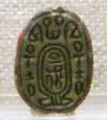
Scarab: tiptop, and engravings.
-

Signet ring, with cartouche of the Pharaoh Tutankhamun :
'Perfect God, Lord of the Ii Lands'–('Neter-Nefer, Pecker-taui') -
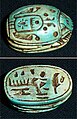
A modern scarab produced for the tourist merchandise.
-
-
Run across besides [edit]
- Cylinder seal
- Dung beetle
- Khepri
- Impression seal
- Anra scarab (artifact)
- Postage stamp seal
Footnotes [edit]
- ^ The dung brawl serves as nutrient and every bit a brood sleeping room in which to lay eggs; this way, the larvae hatch and are immediately surrounded by food.
References [edit]
- ^ a b Aldred, Cyril (1971). Jewels of the Pharaohs Egyptian Jewellery of the Dynastic Menstruation. Thames and Hudson. pp. 160–161. ISBN0500231389.
- ^ Burlingame, Liz (23 Aug 2013). "Sunken Treasures: The world's well-nigh valuable shipwreck discoveries". The Conditions Channel.
- ^ Daphna Ben-Tor: Scarabs, A Reflection of Aboriginal Egypt, Jerusalem 1989 ISBN 965-278-083-9, p. 8
- ^ Ward, William. "Beetles in Stone: The Egyptian Scarab". Manufacture. The Biblical Archaeologist. Retrieved 28 September 2013.
- ^ Ben-Tor, Daphna (1989). Scarabs, A Reflection of Aboriginal Egypt. Jerusalem. p. eight. ISBN965-278-083-9.
- ^ "ROM Images". rom.on.ca.
- ^ Evans, Elaine. "The Sacred Scarab". McClung Museum . Retrieved 28 September 2013.
- ^ Ward, John. The Sacred Protrude: A Popular Treatise on Egyptian Scarabs in Art and History. London: John Murray Co. 1902.
- ^ Andrews, p.56ff
- ^ Andrews, p.59
- ^ John Ward. The Sacred Protrude: A Popular Treatise on Egyptian Scarabs in Art and History. London: John Murray Co. 1902.
Sources [edit]
- Andrews, Ballad, 1994. Amulets of Aboriginal Egypt, chapter 4: Scarabs for the living and funerary scarabs, pp 50–59, Andrews, Ballad, c 1993, Academy of Texas Press; (softcover, ISBN 0-292-70464-X)
- "Ancient Egyptian Scarab Amulet with Wings". australianmuseum.net.au. 22 September 2009. Retrieved eighteen September 2013.
- Ben-Tor, Daphna. "Egyptian-Levantine Relations And Chronology In The Heart Bronze Historic period: Scarab Research." The Synchronisation Of Civilisations In The Eastern Mediterranean In The 2nd Millennium B.C. Two. N.p.: n.p., northward.d. 239". Academia.edu. Retrieved 17 September 2013.
- Blankenberg-van Delden, C., 1969. The large commemorative scarabs of Amenhotep Three. Documenta et Monumenta Orientis Antiqui, Vol. 15. Leiden: E.J. Brill. ISBN 978-xc-04-00474-0.
- Budge, 1977, (1926). The Dwellers on the Nile, E. A. Wallis Budge, (Dover Publications), c 1977, (originally, c 1926, past Religious Tract Guild, titled equally: The Dwellers on the Nile: Chapter of the Life, History, Faith and Literature of the Ancient-Egyptians); pp 265–68: "account of the hunting of wild cattle by Amenhetep III", "taken from a great scarab"; (there are sixteen registers-(lines) of hieroglyphs); (softcover, ISBN 0-486-23501-7)
- Evans, Elaine A. (17 April 1997). "Sacred Scarab". McClung Museum. N.p. Retrieved 17 September 2013.
- Kerrigan, Michael. "Tiy'southward Hymeneals Scarab." The Ancients in Their Ain Words. N.p.: Fall River, 2009. 54-55. Print.
- Newberry, Percy Eastward. (1908). Scarabs: an introduction to the study of Egyptian seals and signet rings. University of Liverpool. Found of archaeology. Egyptian antiquities. London: Archibald Constable & Co; With forty-four plates and 1 hundred and sixteen illustrations
{{cite book}}: CS1 maint: postscript (link) - Patch, Diana Craig. "Exhibitions: Magic in Miniature: Ancient Egyptian Scarabs, Seals & Amulets". Brooklyn Museum Archive, northward.d. Retrieved 18 September 2013.
- Schulz, R., Seidel, M. Egypt, The World of the Pharaohs, Eds. Regine Schulz and Matthias Seidel, (w/ 34 contributing Authors), (Konemann, Germany), c 1998. ( two ) Scarab seals, (as impression seals), (Top/Lesser, 1.five cm), and "Commemorative Scarab" of Amenhotep III, (Top/Bottom hieroglyphs), p. 353. (hardcover, ISBN iii-89508-913-three)
- Sparavigna, Amelia Carolina. "Ancient Egyptian Seals and Scarabs". The Ancient Seals. Torino, Italia: n.p., 2009. Due north. pag.: academia.edu. Retrieved 17 September 2013.
{{cite web}}: CS1 maint: location (link) - "Stamp Scarab Seal with Winged Figures [Levant or Syrian arab republic] (Bequest of Due west. Gedney Beatty 1941 (41.160.162))". Heilbrunn Timeline of Art History. The Metropolitan Museum of Art. 4 September 2013. Retrieved 18 September 2013.
- Ward, John, and F. L. Griffith. The Sacred Beetle: A Popular Treatise on Egyptian Scarabs in Fine art and History. Five hundred examples of scarabs and cylinders, the translations by F. Llewellyn Griffith. London: John Murray, 1902. OCLC 1853124
External links [edit]
- one.1 cm Scaraboid impression seal. Hapy, Nile god holding H2o-vessel, and kneeling on hieroglyph for "Lord", "Lord of the Nile". (Click on moving picture. Height, and bottom views.)
- 'Positive-impression' cowrie-scaraboid. Collection of Ten scaraboid seals. (Click on motion-picture show. Top, and bottom views.)
- Hatshepsut: from Queen to Pharaoh, an exhibition catalog from The Metropolitan Museum of Fine art (fully available online as PDF), which contains a significant amount of material on scarabs (see index)
- Scarab beetles and the people of Ancient Egypt Great video on scarab beetles.
- Middle Scarab Amulet Picture show of a Heart Scarab Amulet from the British Museum
hughesdeforgand99.blogspot.com
Source: https://en.wikipedia.org/wiki/Scarab_(artifact)

Post a Comment for "N Egyptian Art the Scarab Beetle Is Associated With"